 Skip to content
Choosing the right dropshipping supplier is one of the highest-stakes decisions for any online store owner in 2026.
Many new sellers make the same mistake: they choose a supplier based mainly on the lowest product price.
But a cheap supplier can become expensive when delayed shipments, inconsistent product quality, hidden fees, and poor customer support start affecting your store.
The goal is not to find the cheapest or most popular supplier. The goal is to find a reliable dropshipping supplier that matches your products, target market, order volume, and growth stage.
The 9-Point Dropshipping Supplier Checklist
Dropshipping Supplier Scorecard
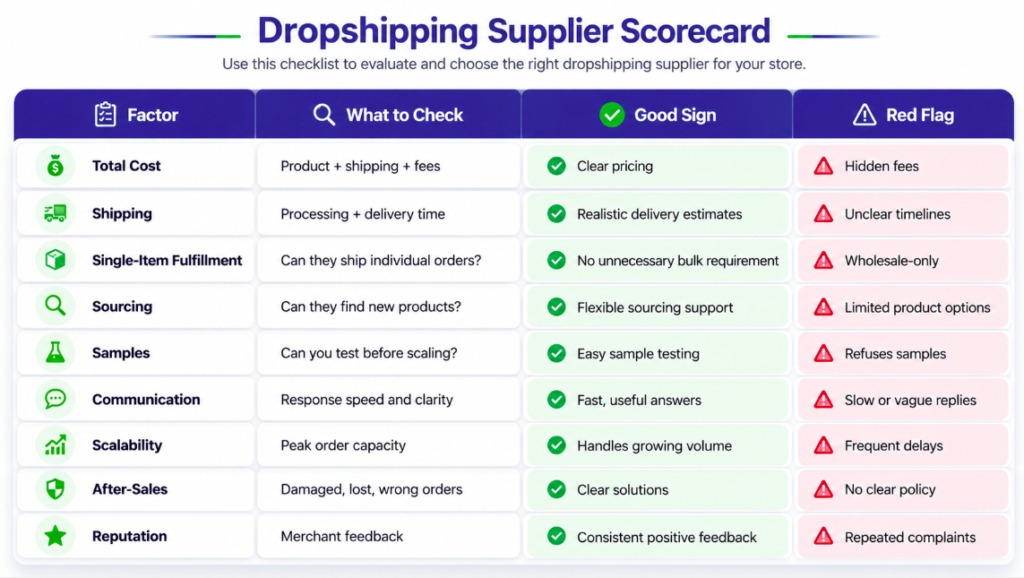
01 💰 Check the Total Cost — Not Just the Product Price
A low product price does not always mean a low-cost supplier.
When comparing dropshipping suppliers, calculate the total cost per order, including:
Product cost
Shipping cost
Processing or handling fees
Packaging fees
Customization costs
Possible return or reshipment costs
For example, Supplier A may offer a product for $5 while Supplier B charges $5.50. However, if Supplier A has higher shipping fees or additional handling charges, Supplier B may actually provide the lower total cost.
What to check:Product Cost + Shipping + Processing Fees + Other Costs = Real Order Cost
02 🚚 Confirm Processing Time and Real Shipping Speed
A supplier’s advertised shipping time is not necessarily the same as your customer’s actual delivery experience.
Ask two separate questions:
How long does it take to process an order?
How long does the shipment usually take to reach the customer?
These are different stages.
A supplier may ship quickly after receiving an order but still use a slow shipping method. During peak seasons, processing times can also increase because of higher order volumes.
What to check:
Average processing time
Available shipping methods
Tracking availability
Actual delivery times to your target market
Peak-season processing capacity
03 📦 Make Sure They Support Single-Item Dropshipping
Not every supplier is designed for dropshipping.
Some manufacturers prefer large wholesale orders and may not want to process individual customer orders.
If you are testing products or running a growing Shopify store, confirm that your supplier supports single-item dropshipping.
Ask:
Can you ship one unit at a time?
Is there a minimum order quantity?
Can you ship directly to my customers?
Can you provide tracking information?
Can orders be processed automatically or efficiently?
04 🔍 Evaluate Their Product Sourcing Capability
A good dropshipping supplier should not only provide products already listed in a catalog.
Your product strategy will change over time.
You may discover a new trend on TikTok, Google Trends, Instagram, or another marketplace and need to find a supplier quickly.
That’s where product sourcing capability becomes important.
A strong sourcing partner should be able to help you:
Find products based on images or product links
Compare different suppliers
Identify suitable manufacturers
Source new trending products
Evaluate product specifications
Support product testing before scaling
05 🧪 Test Product Samples Before Scaling
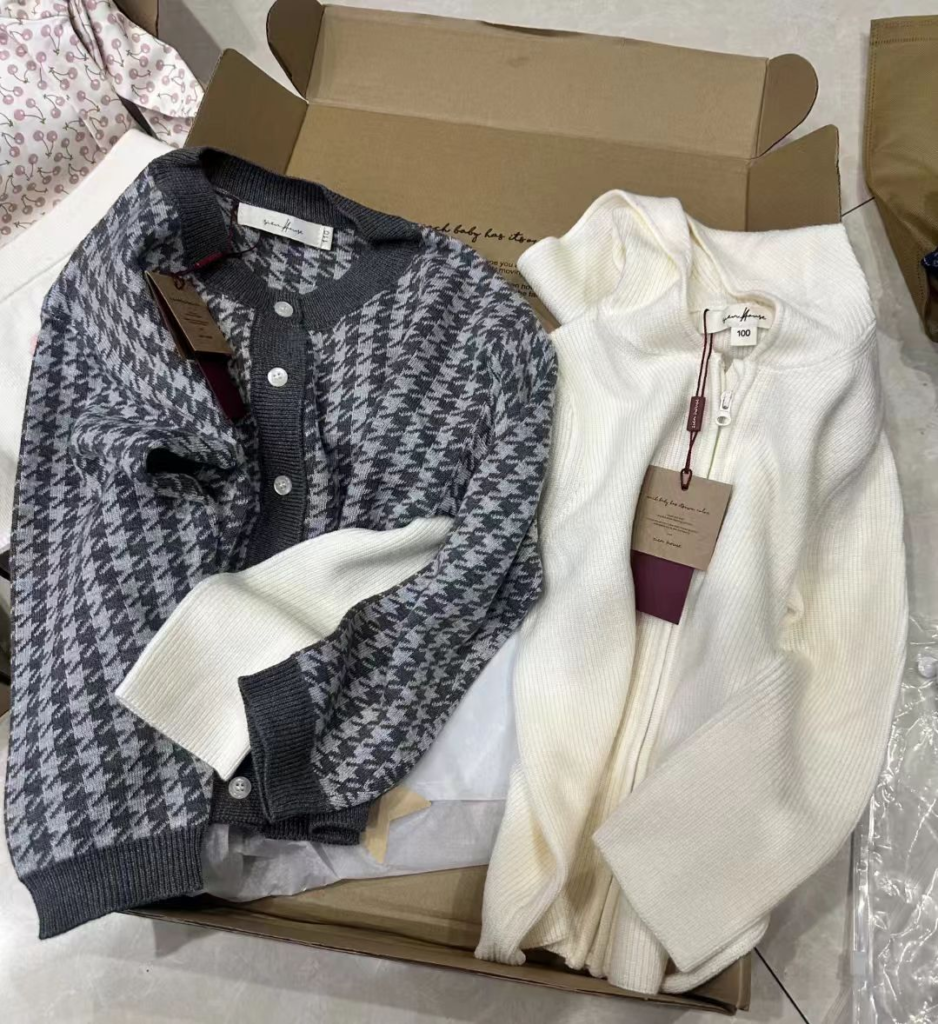
Sample check: Product quality, packaging, and actual fulfillment experience.
Never scale a product based only on supplier photos.
A sample allows you to experience the product from your customer’s perspective before spending heavily on advertising.
When testing a sample, check:
Product Quality: Does the actual product match the listing?
Packaging :Is the product protected during shipping?
Appearance :Does the product look professional enough for your target market?
Shipping Experience: How long does the shipment actually take?
Customer Experience: Would you be comfortable sending this product directly to your customer?
A sample can reveal problems that product photos and supplier descriptions cannot.
Why Sample Testing Matters
Testing a sample before scaling helps you reduce the risk of refunds, negative reviews, and unexpected product-quality problems.
06 💬 Test Communication Before You Need Help
Communication often looks unimportant when everything is going smoothly.
It becomes extremely important when something goes wrong.
Imagine receiving a customer complaint about a damaged product. If your supplier takes two or three days to respond, your customer may already be asking for a refund.
Before committing to a supplier, test their communication.
Ask practical questions about:
Product availability
Processing times
Shipping methods
Sample orders
Returns
Damaged products
Tracking information
Custom packaging
Pay attention not only to how fast they respond, but also to whether their answers are clear and useful.
07 📈 Check Whether They Can Handle Order Growth
A supplier may perform perfectly when you have 10 orders per day.
The real test comes when you suddenly have 100, 500, or more.
This is especially important during Black Friday, Christmas, and other major shopping periods.
Ask your supplier:
How many orders can you process per day?
What happens when order volume suddenly increases?
Will processing time change during peak season?
Can inventory be replenished quickly?
How do you handle stock shortages?
You don’t want your winning product to become your biggest operational problem.
08 🔄 Understand Their Policy for Problem Orders
Problems will happen in ecommerce.
Packages can be delayed. Products can arrive damaged. Customers can receive the wrong item.
The important question is not whether problems happen.
It’s what your supplier does when they happen.
Before cooperation, clarify:
What happens if a product arrives damaged?
What happens if the wrong product is shipped?
What happens if a parcel is lost?
Who pays for reshipment?
How are refunds handled?
How long does a dispute take to resolve?
A clear after-sales process can save your customer service team a huge amount of time.
09 ⭐ Check Real Merchant Feedback
Never evaluate a supplier based only on their own website or sales pitch.
Look for real experiences from merchants.
Pay attention to repeated complaints about:
Long processing times
Unstable inventory
Wrong products
Poor product quality
Missing tracking information
Slow communication
Difficult refunds
Unexpected fees
One negative review does not automatically mean a supplier is bad.
Look for patterns.
Quick Dropshipping Supplier Checklist
- Do I know the total cost per order?
- Have I confirmed the actual processing and shipping times?
- Does the supplier support single-item dropshipping?
- Can they source products that are not already in their catalog?
- Have I tested product samples?
- Does the supplier communicate quickly and clearly?
- Can they handle higher order volumes?
- Do they have a clear policy for damaged, lost, or incorrect orders?
- Have I checked real merchant feedback?
Why the Right Supplier Matters More as Your Store Grows
When you are just starting, choosing a supplier can feel like a simple product-price comparison.
But as your store grows, the supplier becomes part of your entire business operation.
Your supplier affects:
Product Quality → Customer Satisfaction
Processing Speed → Delivery Experience
Shipping Reliability → Refund Rate
Sourcing Capability → Product Testing
Order Capacity → Business Scalability
After-Sales Support → Customer Service
This is why the cheapest supplier is not necessarily the best supplier.
How Yoofar Supports Product Testing and Fulfillment
Finding the right supplier can take time, especially when you need to compare products, sourcing options, fulfillment, and shipping.
Yoofar supports sellers with product sourcing, one-piece dropshipping fulfillment, and order processing, allowing sellers to test products before committing to larger quantities.
The process can be simple:
Find a Product → Source It → Test It → Start Selling → Scale the Winner
This approach allows sellers to validate products first instead of taking unnecessary inventory risks.
For stores testing multiple products, having sourcing and fulfillment support in the same workflow can also make it easier to move from product testing to regular order fulfillment.
With Q4 holiday sales coming soon, you can also check our Q4 dropshipping preparation tips to get fully prepared for the upcoming peak selling season.
Final Thoughts
Choosing a dropshipping supplier in 2026 is not simply about finding the lowest product price.
A reliable supplier should support the entire process, from product sourcing and sample testing to fulfillment, shipping, communication, and problem-order resolution.
Before choosing a partner, test the supplier yourself.
Order samples. Ask practical questions. Calculate the real cost. Check shipping performance. Read merchant feedback.
Most importantly, don’t choose a supplier based on one attractive number.
FAQ
- Q1: What is the most important factor when selecting a dropshipping supplier in 2026?
Price should not be your only priority.
Overall reliability matters more, including processing speed, shipping performance, product quality, communication, and after-sales support.
Always calculate the total cost per order instead of comparing product prices alone.
- Q2: Should I order samples before working with a new dropshipping supplier?
Yes.
Sample testing allows you to check real product quality, packaging, shipping experience, and whether the product matches the supplier’s description.
It is one of the easiest ways to reduce problems before scaling a product.
- Q3: Can one dropshipping supplier handle large order growth?
Not every supplier can scale at the same speed.
Before working with a supplier, ask about daily processing capacity, inventory availability, peak-season operations, and what happens when order volume increases suddenly.
- Q4: What should I ask a dropshipping supplier before placing an order?
Ask about product cost, shipping fees, processing time, minimum order requirements, tracking information, sample orders, product sourcing, inventory availability, and after-sales policies.
The more specific your questions are, the easier it is to identify potential problems before cooperation.
- Q5: What red flags should I watch for when choosing a dropshipping supplier?
Common warning signs include unclear shipping times, hidden fees, poor communication, unwillingness to provide samples, unstable inventory, unclear refund policies, and repeated complaints from other merchants.
One negative review is not necessarily a problem, but repeated complaints about the same issue deserve attention.
- Q6: Is a low product price always better for dropshipping?
No.
A low product price can be offset by expensive shipping, additional fees, poor quality, higher refund rates, or unreliable fulfillment.
The better comparison is the total cost per successfully delivered order.
- Q7: Can I test products without buying large quantities?
Yes, depending on the supplier’s fulfillment model.
Single-item dropshipping allows sellers to test products without committing to large inventory purchases. Once a product demonstrates stable demand, sellers can consider larger-volume purchasing or other fulfillment options.