 Skip to content
“Is dropshipping dead in 2026?”
This question has been repeatedly asked across Google, WikiHow, and Reddit. The answers are sharply divided: some call it a “passive income machine,” while others describe it as a “cash-grab scheme for beginners.”
We’re not here to hype you up, nor to discourage you. Instead, this article aims to do one thing: outline several key shifts that have already taken place in the cross-border eCommerce industry, reference widely recognized industry trends and insights, and let you decide for yourself—whether now is the right time for you to enter the market.
It is widely acknowledged that the industry has become more challenging—this is a consensus, not a secret.
If you feel that entering the market today is harder than it was a few years ago, that’s not just your perception. The following changes are widely acknowledged across the industry:
1. Rising traffic costs are irreversible
The era of “cheap traffic dividends” in cross-border eCommerce is over—and this is not a feeling, but a data-backed reality.
According to research from the eCommerce analytics platform SimplicityDX, customer acquisition cost (CAC) in the eCommerce industry has surged by 222% in just a few years. On average, merchants have gone from losing $9 per new customer to losing $29 per acquisition.
This number reveals a harsh but unavoidable truth: the days when you could “run a few ads and easily make money” are truly over. But does this mean there are no opportunities left for everyday beginners? Let’s stay grounded and analyze the facts.
2. Platform regulations are becoming stricter, and the tax-free dividend era is ending
Tax exemption policies for low-value parcels, especially in the EU, are being tightened.
Starting July 1, 2026, the European Union will eliminate the long-standing customs duty exemption for cross-border parcels valued under €150 and introduce a temporary fixed tariff of €3 per item.
This regulatory shift effectively marks the end of the “tax-free dividend” that once supported low-ticket dropshipping models.
3. Supply chain expectations for speed are significantly higher
The era of “packages taking a month to arrive” is gone. Consumer expectations around fulfillment speed have been reshaped by platforms like Amazon Prime and TikTok Shop, and they are now far more demanding.
According to Shopify’s Global Ecommerce Statistics and Trends, delivery speed has become one of the core factors influencing purchase decisions and brand loyalty in eCommerce.
This means that for beginners today, the ability to connect with a reliable, fast-moving supply chain directly determines whether a store can survive. Choosing a partner like Youfar, which has stable fulfillment capabilities, is no longer a “nice-to-have”—it has become a basic entry requirement.
But why is this still an opportunity for “serious beginners”?
However, why is this still an opportunity for “serious beginners”?
Industry difficulty does not mean industry disappearance. Periods of restructuring are often also windows for establishing a new order. The following two trends are creating new entry points for newcomers:
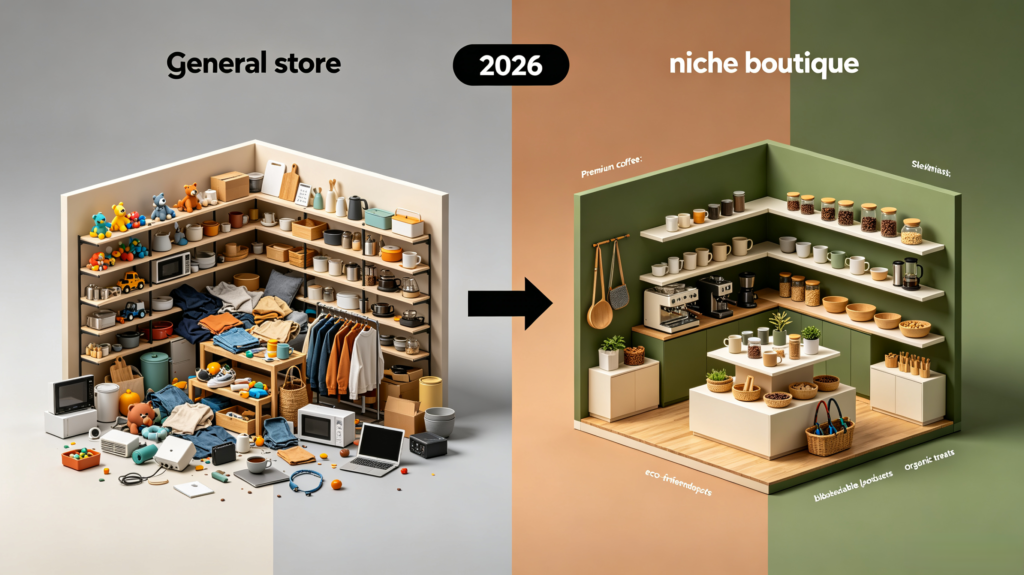
1. The irreversible shift from “general stores” to “niche boutiques”
In the past, dropshipping was often associated with “general stores”—selling everything without specialization or focus. However, in reality, most independent stores that have survived and are thriving today are “niche stores” that deeply focus on a specific segment.
In Shopify’s official blog discussion on Niche Marketing, one core strategy is repeatedly emphasized: “niche down.” The platform clearly points out that compared with general stores selling everything, niche stores that focus on a specific audience and deliver a clear brand message are more likely to attract targeted traffic.
Behind this is a fundamental shift in consumer behavior. In today’s world of product overabundance, people are no longer looking for another “mini Amazon.” Instead, they are searching for expert brands that understand them and serve their specific needs.For beginners who may lack resources but have passion and a willingness to go deep into a niche, rather than competing on price in a crowded red ocean, it makes more sense to aim to become number one in a smaller, well-defined market.
2. The shift from “solo operation” to professional specialization
The dropshipping model itself is also evolving. In the past, beginners often had to handle everything alone—product selection, store building, logistics, customer service, compliance. A single weak link could cause the entire store to fail.
Today, however, the industry has entered an era of specialization. Outsourcing supply chain and fulfillment to professional platforms, while focusing on the areas where real competitive advantage can be built, has become the most practical survival strategy for 2026.
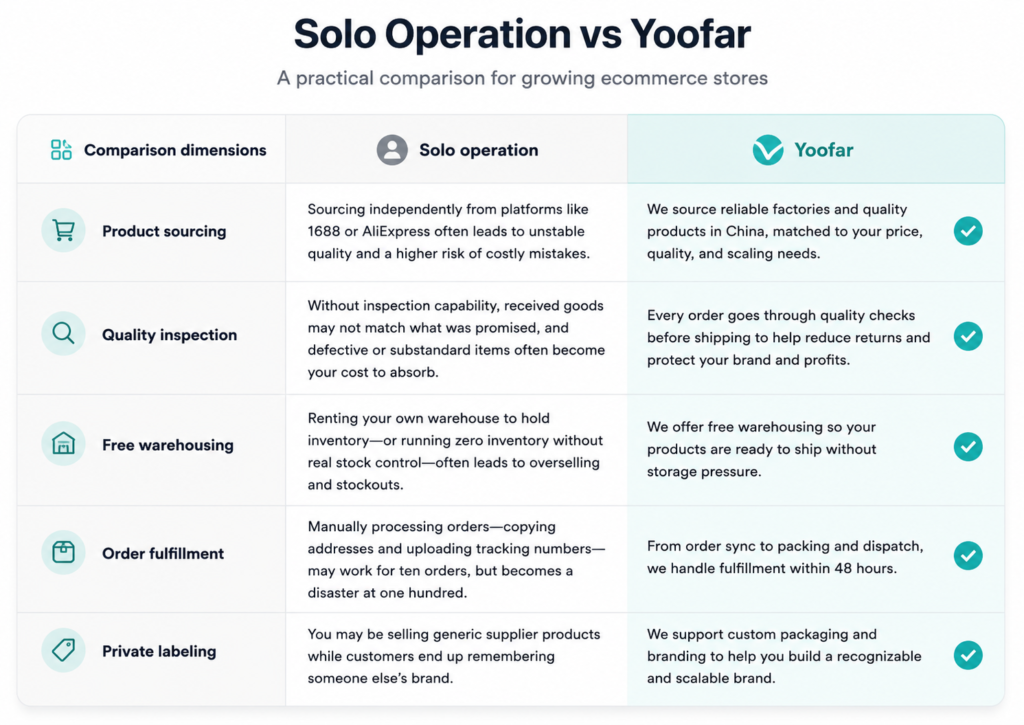
Below are Yoofar unique advantages:
Two Key Recommendations for Dropshipping Beginners in 2026 — and How Yoofar Can Help
By now, you might be thinking: the industry is harder, but there are still opportunities—so how do I actually get started?Below are two of the most practical recommendations we believe can help beginners avoid the most common pitfalls.
Recommendation 1: Don’t chase “winning products”—start with a niche you actually understand
Many beginners start by asking: “What sells best right now?” But this question itself is a trap. Winning products are a never-ending chase, and by the time you hear about something trending, it’s usually already a saturated market.
A better question to ask is: Which niche do I genuinely understand? Camping, baking, pets, coffee, cycling?
Your understanding and passion for a specific niche are your most reliable product selection compass. Because only when you truly understand an audience can you write product descriptions that resonate and create content that connects—and that is something no ad budget can buy.
How Yoofar can help: We don’t hand out a “universal winning product list.” But once you define your direction, we help you quickly match it with products that have stable supply and reliable quality within that niche.
Recommendation 2: Let specialists handle specialized work—focus only on what makes you irreplaceable
This is the core idea we emphasized repeatedly in the comparison section above.
Product selection, content creation, and understanding your customers—these are your core responsibilities as a founder. No one can replace you here.
But sourcing, quality inspection, warehousing, packaging, fulfillment, and customs documentation—these are repetitive, low-margin-for-error operations that should absolutely be handled by professional supply chain partners.
How Yoofar can help: From product sourcing and quality inspection, to free warehousing, order fulfillment, shipping and delivery, and even private label customization—Youfar takes care of all the “unsexy but critical” parts of dropshipping.
This allows you to confidently invest your energy where it actually creates differentiation, and where real competitive advantage is built.
If you’re looking for a partner that can help you handle the complexity of your supply chain—so you can focus on understanding your customers and building trust—feel free to take a look at Yoofar. We provide eCommerce sellers with reliable end-to-end solutions, from product sourcing to fulfillment.
Refference
- Press Release – Brands Losing a Record $29 for Each New Customer Acquired
- Niche Market: Definition & 11 Examples (2026)