 Skip to content
If you are an independent e-commerce seller or dropshipper heavily focusing on the European market, you must sound the highest level of red alert immediately.
The Union Customs Code (UCC) Reforms have entered the ultimate countdown to implementation. With the recent landmark political agreement reached between the European Parliament and the Council, the cross-border e-commerce “rules of the game” that have stood for decades are about to be completely overturned.
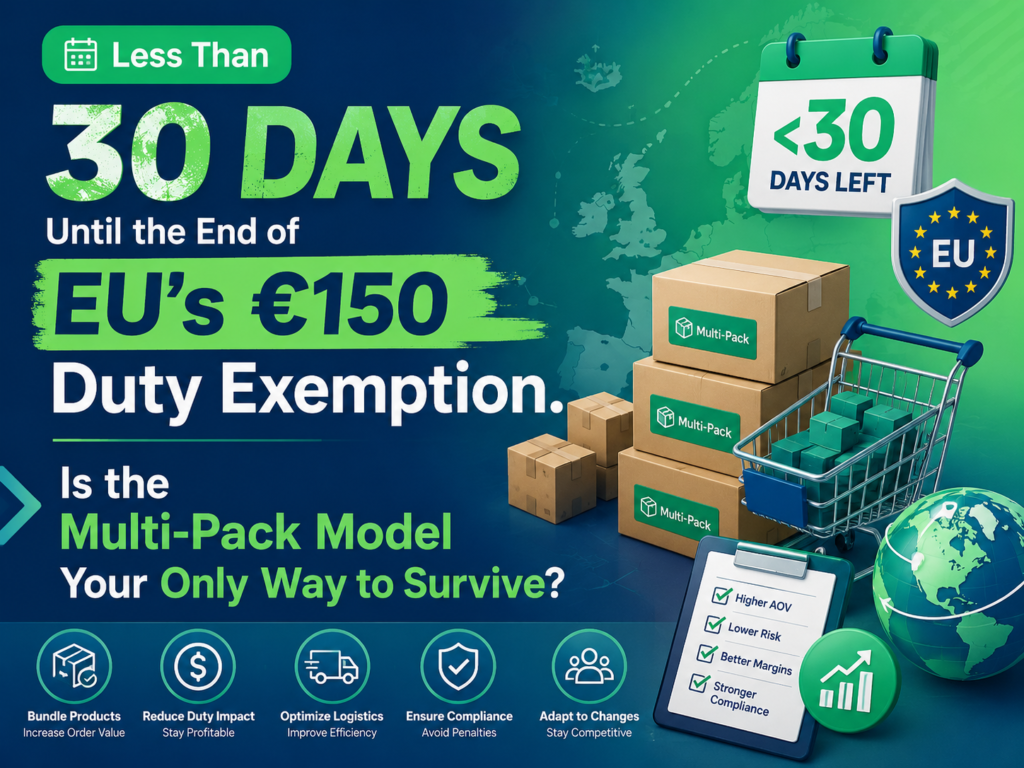
This is by no means a minor tariff adjustment; it is a precise regulatory siege targeting cross-border direct shipping and the zero-inventory (Dropshipping) model. For overseas sellers who rely heavily on healthy margins and fast logistics, the window for supply chain adjustment is now less than 30 days.
Hardcore Official Data: Why is the EU "Overturning the Table"?
Before looking at the specific policies, let’s examine a set of eye-opening audit data disclosed by the European Commission. It explains exactly why European regulators are taking such aggressive and decisive measures:
The Shockwave of 5.9 Billion Parcels: Official statistics show that an estimated 5.9 billion low-value items (under €150) entered the EU via cross-border parcels shipped directly to consumers.
90%+ Purely Non-EU Sourced: Out of this massive influx of 5.9 billion parcels, over 90% originated directly from non-EU countries (primarily driven by Chinese supply chains). Traditional EU local brick-and-mortar retail and local e-commerce lost almost all price competitiveness against this massive “lightweight tsunami.”
The 65% Under-Reporting Black Hole: Customs audit data revealed that nearly 65% of these tax-exempt small parcels involved deliberate under-reporting of cargo value or malicious split-shipping (breaking orders down to stay below €150 to evade customs duties).
A €2 Billion Financial Incentive: The EU predicts that by establishing a brand-new Customs Data Hub and completely plugging the small parcel tax exemption loophole, it will save member states over €2 billion annually in operational costs and recovered taxes alone.
Faced with such massive losses in tax revenue, the EU has completely run out of patience.
Two Critical "Margin Meltdown" Deadlines to Memorize
This time, the EU has set a tighter timeline than ever before. Mark these two dates in red on your operational calendar:
Phase 1: July 1, 2026 | The End of Tax-Free Advantages & The Introduction of the €3 Flat Duty
The Tax-Free Era Ends: The long-standing customs duty relief threshold for parcels valued below €150 is completely abolished. Even if you sell a hair tie worth €0.50, it must undergo full customs declaration and pay full duties upon entering the EU.
“Item-Based” Interim Customs Duty: To bridge the gap before the centralized customs data system is fully digitalized (from July 1, 2026, to July 1, 2028), low-value parcels under €150 will be subject to a flat duty of €3 per product category.
Phase 2: November 1, 2026 | An Additional €2 "Customs Handling Fee"
Don’t think it stops at €3. Due to the skyrocketing administrative, IT, and labor costs associated with customs modernization, the Council decided to introduce a specific handling fee of €2 per parcel, no later than November 1, 2026.
What this means: By the end of 2026, before a direct-shipped parcel even lands, a €5 fixed compliance dead cost will already be locked into your balance sheet.
Deep Dive: The Fatal Impact of "Item Lines" on Multi-PCS Sales
For overseas dropshippers, the most critical underlying logic of this new policy is that the €3 flat duty is levied per “Item Line” (i.e., different product categories/HS Codes) on the customs declaration form, NOT per parcel!
This specific rule splits future dropshipping sales models into two extremes: Hell and Heaven.
Cross-Category Bundling Transforms into a Profit Black Hole
Many independent site sellers love using apps to upsell cross-category bundles on the checkout page to raise Average Order Value (AOV). For example: “Buy a handbag (Category A), get a pair of sunglasses (Category B) and a pair of stockings (Category C) for an extra $5.”
In the past: Packing these three different categories into one bag for direct shipping was completely tax-exempt as long as the total value was under €150.
Now: The handbag, sunglasses, and stockings belong to three completely different HS Codes, taking up 3 Item Lines on the declaration form. This triggers 3 × €3 = €9 in flat customs duties! Layer on the €2 handling fee, and you are hit with €11 in taxes alone before the parcel even lands. Your bundle didn’t make money; you just worked for free for EU Customs.
Same-Category Multi-PCS Sales (Multi-Packs / Quantity Tiers) Become Your Only Path to High Margins
Under the new regulations, if you sell multi-PCS combinations of the exact same product/category (e.g., a 2-pack massage gun, a 3-pack plain white T-shirt, a 5-pack of identical underwear), the situation undergoes a dramatic reversal.
The Underlying Logic: Because it is the exact same product, no matter if you pack 1 or 5 pieces in a single parcel, it only occupies 1 Item Line on the declaration form, corresponding to a single HS Code.
The Math:
If you sell 1 piece: You bear €3 duty + €2 handling fee = €5/item in compliance costs.
If you leverage quantity tiers (Buy 2 Get 10% Off / Buy 3 Get 20% Off) to sell 3 pieces of the same category product: The entire parcel is still only charged €3 duty + €2 handling fee = €5. Amortized across the order, your compliance cost instantly drops to €1.67/item!
💡 Core Operational Advice: Overseas dropshippers must immediately dismantle all “cross-category mixed” promotional bundles. Instead, completely redesign your product landing pages to push Same-Product Multi-Packs. Using a higher AOV to offset and dilute the fixed €5 regulatory fee is your only margin antidote for the direct-shipping model in the second half of 2026.
On the Edge of the Cliff: How Overseas Dropshippers Can Survive the Storm
The rules have changed completely. If you don’t want to be wiped out, execute these three supply chain restructuring steps immediately:
Fully Embrace DDP and the IOSS Green Channel: This €3 simplified flat duty is a privilege exclusive to sellers registered with IOSS (Import One-Stop Shop). Non-IOSS parcels will be forced into tedious local customs clearance and slapped with high, traditional ad valorem tariffs. Sellers must use the DDP (Delivered Duty Paid) model at checkout to clear the €3 tax transparently for consumers. Otherwise, prepare for a disastrous wave of customer rejections, returns, and Stripe/PayPal account bans.
Filter for Partners with “Deep-Level” Digital Capabilities: By the end of 2026, the EU will mandate data transparency down to the SKU and Manufacturer ID. Traditional, unsophisticated fulfillment agents simply lack the capability to integrate such complex API data streams. Finding a professional, flexible supply chain partner that can automatically classify HS Codes and seamlessly integrate with your IOSS declaration pipeline will become your core competitive moat.
- With the €3 per-category customs duty and additional handling fee coming into force across the EU, selling only single items will squeeze your earnings significantly. We recommend designing multi-product bundles and volume deals to increase your average order value. By distributing the fixed extra costs over multiple products per order, you can minimize the impact of new taxes and maintain healthy revenue for your store.
Why Choose yoofar today?
As EU policies continue to evolve, the pressure on your supply chain will only increase, especially when it comes to compliance, cost control, and delivery stability.
This is where having the right fulfillment partner can make a real difference.
At Yoofar, we support e-commerce sellers with reliable logistics solutions, including IOSS-enabled shipping for smoother EU deliveries. Our pricing structure is fully transparent, so you can clearly understand your costs and protect your margins.
More importantly, our dedicated agents work closely with you in real time — monitoring policy updates, adjusting fulfillment strategies, and helping you respond quickly to changes. The goal isn’t just to ship orders, but to help you reduce disruption, minimize unexpected costs, and keep your operations running efficiently.
If you’re currently reviewing your EU strategy or feeling the impact of these changes, it may be a good time to reassess your supply chain setup.
Feel free to reach out if you’d like a tailored quote or simply want to explore what options are available for your business.
References & Official Sources
To ensure the accuracy and authority of the policies, timelines, and audit data mentioned above, all contents in this article are cited from the following official European Union legislative documents:
European Commission Official Announcement (Press Release)
Title: Commission welcomes today’s agreement between the European Parliament and the Council, delivering a landmark reform of the EU Customs Union.
Core Data: Disclosed the data of 5.9 billion e-commerce parcels in 2025 (90%+ from non-EU origins) and established the roles of the EU Customs Authority (EUCA) in Lille, France.
Directorate-General for Taxation and Customs Union (DG TAXUD)
Title: E-commerce: 150 EUR customs duty exemption threshold to be removed as of 2026 (Published on 13 November 2025).
Core Resolution: Member states unanimously agreed to remove the €150 customs duty exemption threshold and established the framework for the simplified interim tariff (€3 flat duty).
European Parliament Resolution
Document Number: Resolution of 9 July 2025 (2025/2037(INI))
Title: Product safety and regulatory compliance in e-commerce and non-EU imports.
Core Content: Provided top-level legislative backing for the complete removal of the low-value parcel tax exemption from the perspectives of product safety, market compliance, and anti-fraud measures.