 Skip to content
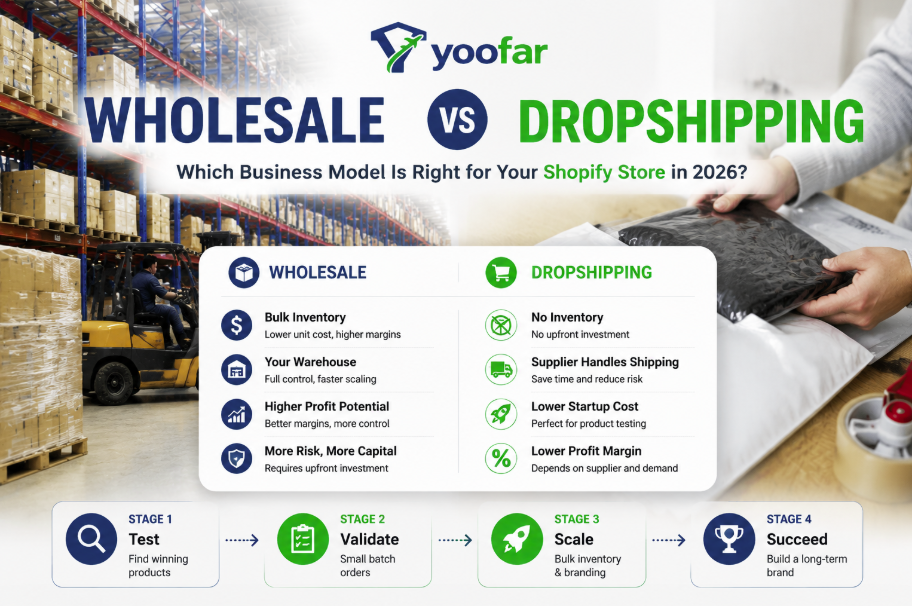
Every Shopify seller eventually faces the same decision: Should you choose wholesale or dropshipping to grow your ecommerce business?
Most get the answer wrong — and pay for it with dead inventory.
For years, ecommerce advice has treated wholesale and dropshipping as opposite choices.
Wholesale is often described as the “serious business model” because sellers purchase inventory, control products, and achieve higher margins.
Dropshipping is sometimes seen as only a beginner strategy because sellers do not hold inventory themselves.
Both descriptions are lies. Wholesale isn’t “serious” — it’s a gamble if you haven’t proven demand.
Dropshipping isn’t “dead” — it’s the only sane way to test. The truth? Your stage decides your model. Not your ego, not guru advice.
The best business model is not determined by which one sounds better.
It depends on:
Your available budget
Your product validation stage
Your risk tolerance
Your growth goals
A beginner seller and an established brand should not use the same fulfillment strategy.
The smartest sellers usually do not choose one forever.
They move between different models as their business grows.
Most ecommerce influencers will push you to jump straight into bulk wholesale.
They rarely talk about thousands of new Shopify sellers sinking startup capital into dead inventory, just chasing “higher per-unit margins”.Quick Decision Guide
Which model fits your current stage?
🟢 Starting a new store?
Choose:Dropshipping
Because you need to test products without large upfront investment.
🟡 Already have winning products?
Consider:Small-batch inventory
Because you can improve margins while controlling risk.
🔵 Building a long-term brand?
Move toward:Wholesale + branded fulfillment
Because stronger control creates better customer experiences.What Is Wholesale Ecommerce?
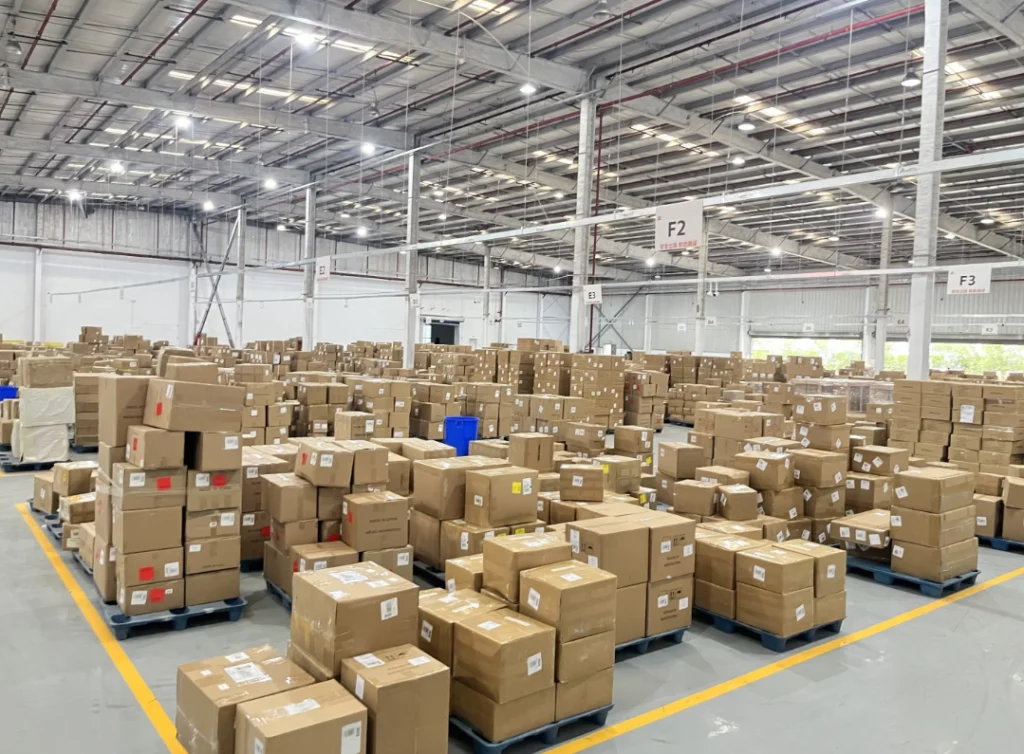
Wholesale means purchasing products in larger quantities directly from suppliers or manufacturers at a lower unit cost.
The seller owns the inventory and is responsible for:
Storage
Packaging
Order fulfillment
Inventory management
For example:
A seller purchases 1,000 units of a product at a discounted price, stores them in a warehouse, and ships orders when customers purchase.
Wholesale is attractive because buying larger quantities usually reduces product cost.
However, lower product cost does not always mean higher profit.
The real question is:
How fast can you sell the inventory?
Advantages of Wholesale
Lower Product Cost
Bulk orders usually create better supplier pricing.
Higher Profit Potential
More control over purchasing can increase margins.
Better Brand Control
Sellers can customize:
Packaging
Inserts
Product presentation
Hidden Risks of Wholesale
Many beginners only focus on the cheaper unit price.
They forget about:
📦 Inventory Storage
Products need physical space.
Warehouse fees continue even when products are not selling.
💰 Cash Flow Pressure
Money is locked inside inventory before customers purchase.
⚠️ Dead Inventory
Trends change.
A product that sells today may become difficult to move tomorrow.What Is Dropshipping?
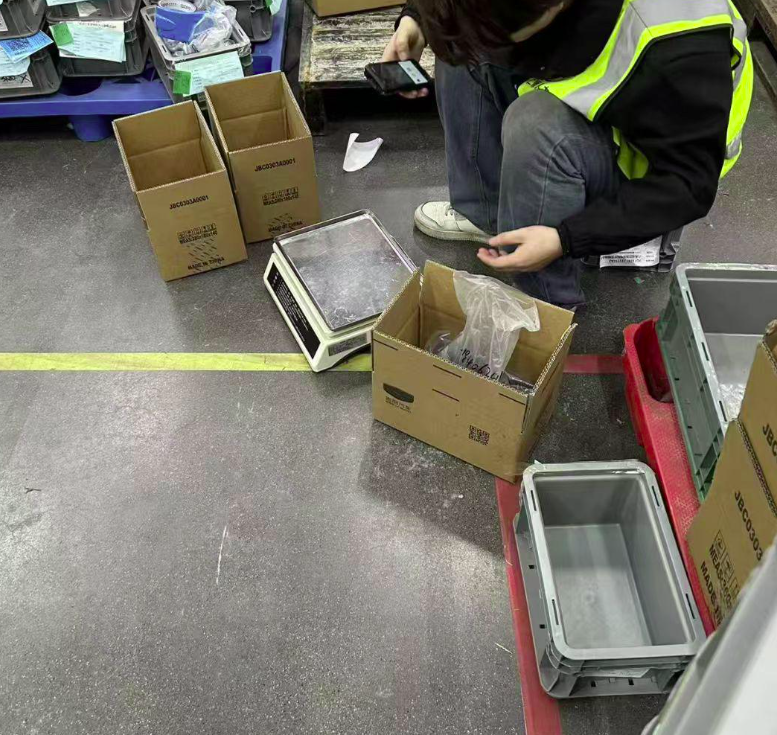
Dropshipping allows sellers to sell products without purchasing inventory upfront.
When a customer places an order:
Customer Order
↓
Store Owner
↓
Supplier
↓
Customer Delivery
The supplier handles inventory storage and product shipment.
This model is popular among new Shopify sellers because it reduces financial risk.
Shopify defines dropshipping as selling products without storing inventory or shipping products yourself, with suppliers fulfilling orders directly.
Advantages of Dropshipping
Lower Startup Risk
You do not need thousands of dollars invested in inventory before knowing if customers want the product.
Faster Product Testing
Sellers can test multiple products and quickly identify potential winners.
More Flexibility
If a product does not perform well, sellers can move on without leftover stock.
The Hidden Problems With Dropshipping
Dropshipping solves inventory problems.
But it creates different challenges.
Lower Control Over Fulfillment
Supplier processing speed directly affects customer experience.
Less Product Differentiation
Many sellers may use similar suppliers and products.
Scaling Requires Better Operations
A product that receives 5 orders per day may work differently when it receives 500 orders per day.
This is where supplier reliability becomes critical.
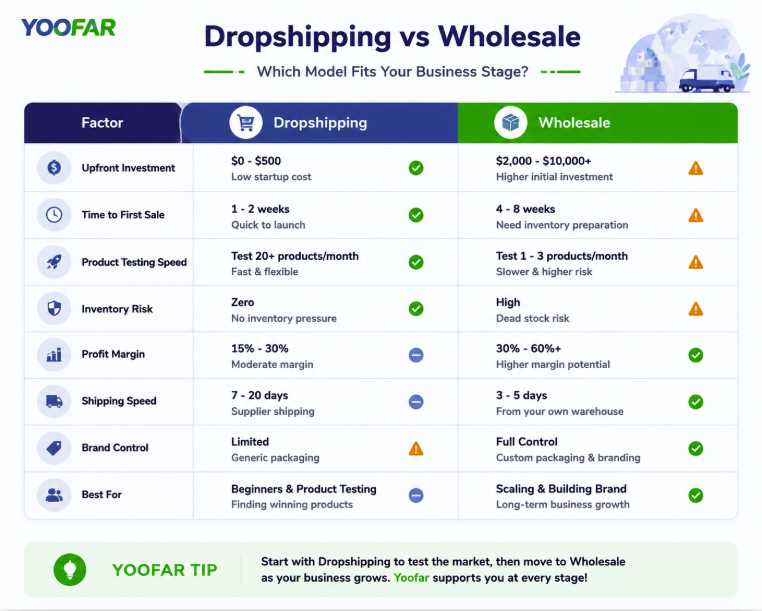
The Biggest Mistake: Choosing the Wrong Model Too Early
Many sellers fail because they choose a business model that does not match their current stage.
A beginner does not need thousands of products sitting in a warehouse.
A growing brand cannot rely forever on random product sourcing.
The right approach is progression.The Smart Growth Path: Dropshipping → Wholesale
Successful sellers often follow this path:
Stage 1: Product Testing
Goal:Find products customers actually want.
Strategy:
✅ Dropshipping
Benefits:
Low risk
Fast testing
No inventory pressure
Stage 2: Product Validation
Goal:Confirm consistent demand.
Strategy:
✅ Small-batch inventory
Example:50-100 units
Benefits:
Better margins
More control
Lower risk than large bulk orders
Stage 3: Brand Scaling
Goal:Build a stronger business.
Strategy:
✅ Wholesale purchasing
✅ Custom packaging
✅ Larger inventory planning
Benefits:
Better customer experience
Stronger brand identity
Higher operational control
Why Smart Sellers Combine Both Models
The debate should not be:“Wholesale or dropshipping?”
The better question is:
“How can you use both at the right time?”
Dropshipping is excellent for discovering opportunities.
Wholesale is powerful for scaling proven winners.
Together, they create a flexible growth system.How Yoofar Helps Sellers Move From Testing to Scaling
Many sellers think they must completely change suppliers when they move from dropshipping to wholesale.
That creates unnecessary problems:
New supplier communication
New quality standards
New fulfillment processes
A better solution is working with a partner that supports different growth stages.
Yoofar helps sellers:
Single-item fulfillment
Product sourcing support
Quality inspection
Validate Winners
Small batch purchasing
Stable supplier communication
Flexible fulfillment options
Scale Successful Products
Bulk order support
Custom packaging solutions
Long-term supply chain cooperation
The goal is simple:
Start with lower risk.
Scale when your sales data proves demand.
Final Verdict: Wholesale vs Dropshipping
There is no universal winner.
The right choice depends on your business stage.
New Seller:
Start with dropshipping.
Focus on testing and learning.
Growing Seller:
Use small batches.
Increase control while reducing risk.
Established Brand:
Consider wholesale.
Build stronger margins and customer experience.
The biggest mistake is choosing the wrong model too early.
Which one are you?FAQ
- Is wholesale more profitable than dropshipping?
Not always.Wholesale can provide better unit costs, but storage fees, unsold inventory, and cash flow pressure can reduce actual profit.
- Can I start with dropshipping and move to wholesale later?
Yes.Many sellers use dropshipping to test products before investing in larger inventory.
- How many products should I test before buying inventory?
There is no fixed number.The important factor is consistent sales data, not the number of products tested.
- Is dropshipping dead in 2026?
No — but lazy dropshipping is. The stores winning in 2026 use reliable suppliers, fast shipping, and quality control. The “list and pray” model is dead.
- What is the biggest risk of wholesale ecommerce?
The biggest risk is buying too much inventory before proving demand.