 Skip to content
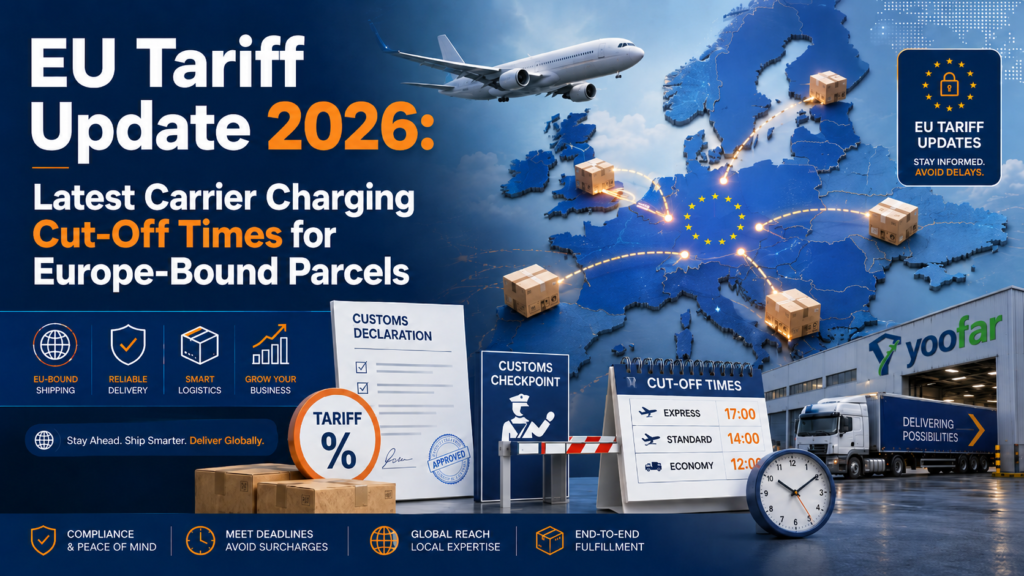
EU Customs Reform Is Now Affecting Dropshipping Fulfillment Costs
For dropshippers shipping products from China to Europe, the EU’s 2026 customs reform is no longer just a future policy change. It is already affecting logistics pricing, carrier route selection, and order fulfillment decisions.
According to the European Commission’s guidance, from July 1, 2026, the EU will remove the long-standing customs duty exemption for cross-border parcels valued under €150 and introduce a temporary fixed customs duty of €3 per item.
In our previous article, we explained how the end of the €150 duty exemption may reshape EU dropshipping margins, product pricing, and China-to-Europe fulfillment strategies:
This new update focuses on a more urgent operational question:
When will logistics providers start charging EU-related customs fees?
This matters because although the official policy starts on July 1, many logistics carriers are adjusting fees earlier based on warehouse check-in time, estimated delivery timelines, and customs clearance risk.
Key Rule: Customs Clearance Date Matters
Based on recent logistics carrier notices collected by Yoofar, sellers should pay close attention to one important rule:
Parcels that complete customs clearance before June 30 may be eligible for a full refund of the pre-collected customs duty.
Parcels that complete customs clearance on or after July 1 will generally not receive a refund for the collected fee.
In other words, the key factor is not only when the parcel leaves the China warehouse. What matters more is whether the parcel can complete EU customs clearance before the new policy takes effect.
For dropshippers, this creates a short but critical transition window. Orders shipped too close to the July 1 deadline may still be affected by the new customs duty, even if they were dispatched before July 1.
Latest EU Tariff-Related Charging Times by Logistics Provider
Below is Yoofar’s current summary of major China-to-Europe logistics providers and their EU tariff-related charging schedules.
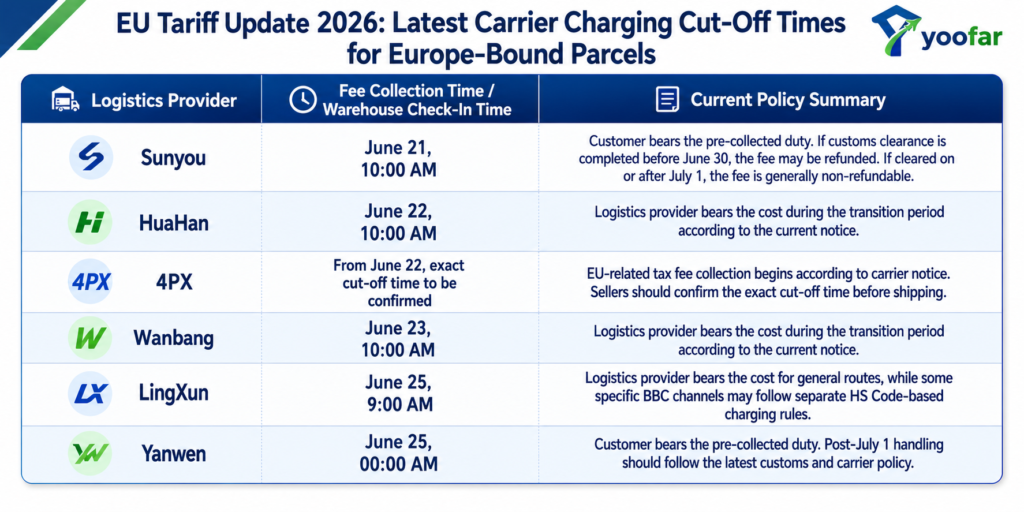
Note on LingXun’s BBC Channel Policy
Some LingXun BBC channels may apply separate customs-related charges based on HS Code / declaration line, especially for selected sensitive, battery-related, and postal routes. Sellers using these channels should check the detailed channel notice before arranging EU dropshipping orders.
What This Means for Dropshippers
For dropshippers, this update is not just a logistics price adjustment. It directly affects product pricing, profit margins, shipping route selection, and the final customer experience.
A small customs-related fee may look manageable at first, but for low-ticket products, free-shipping offers, or products with thin margins, the impact can be significant. Sellers who rely heavily on EU dropshipping should review their fulfillment setup as early as possible.
1. Shipping early does not guarantee avoiding the fee
The most important point is customs clearance completion, not simply dispatch time.
A parcel shipped in late June may still be charged if it completes EU customs clearance on or after July 1. Dropshippers should avoid waiting until the final days of June to process EU-bound orders.
2. Product bundles may need to be reviewed
Some customs-related costs may be affected by HS Codes or declaration lines. This means mixed-category bundles may create more cost pressure than same-category multi-pack offers.
For example, a bundle containing a bag, sunglasses, and socks may involve several different HS Codes. A 3-pack of the same product category may be easier to declare and may create a more predictable cost structure.
For dropshipping stores, this means product bundling should not only be designed for higher AOV, but also for smoother fulfillment and customs declaration.
3. Low-ticket products may face higher margin pressure
The €3/item temporary duty can have a much larger impact on low-value products than on higher-value products.
For example, a €3 customs duty on a €9 product is a major cost increase. On a €49 product, the impact is relatively easier to absorb.
Dropshippers selling low-ticket items to EU customers should review pricing, shipping fees, product selection, and whether certain products are still suitable for the EU market after the policy change.
4. Carrier selection becomes more important
Different logistics providers are applying different transition policies. Some carriers are pre-collecting the duty from customers, some are temporarily absorbing the cost, and some channels may apply route-specific or HS Code-based charging rules.
This means dropshippers should not assume that all China-to-Europe shipping routes are using the same charging model.
Before dispatching orders, sellers should confirm:
- Warehouse check-in cut-off time
- Charging method
- Refund rule
- Destination country coverage
- Whether the route is DDP, tax-inclusive, or subject to separate customs charges
- Whether product category or HS Code affects the final cost
Yoofar’s Recommendation for EU Dropshipping Sellers
To reduce risk during this transition period, Yoofar recommends that sellers take the following actions immediately.
First, process urgent EU orders as early as possible.
If you want to increase the chance of completing customs clearance before July 1, do not wait until the end of June to ship.
Second, review your product pricing.
EU-bound orders should be recalculated with customs-related costs included. Dropshippers should pay extra attention to low-ticket products, free-shipping strategies, and high-discount offers.
Third, check product categories and HS Code risks.
If your store sells mixed bundles or products across multiple categories, review whether the declaration structure may increase customs-related costs.
Fourth, confirm logistics channel rules before fulfillment.
Carrier policies may differ by route, destination country, product category, and warehouse check-in time. Always confirm the latest notice before arranging shipment.
Finally, work with a reliable China dropshipping agent or fulfillment partner.
During policy changes like this, sellers need more than just cheap shipping. They need clear communication, stable routes, accurate declaration support, and fast operational response.
How Yoofar Helps Dropshippers Manage EU Fulfillment
Yoofar helps e-commerce sellers and dropshippers manage China-to-global fulfillment, including product sourcing, order processing, warehouse support, quality control, and international logistics.
For sellers affected by the EU customs reform, Yoofar can help with:
- China-to-Europe dropshipping fulfillment
- EU logistics route comparison
- DDP and tax-inclusive shipping options
- Product sourcing and supplier coordination
- HS Code and product category review
- Order fulfillment through China warehouse support
- Overseas warehouse solutions for faster local delivery
- EU warehouse fulfillment support for sellers with stable order volume
- Inventory planning and stock preparation before peak seasons
- Logistics cost optimization during policy changes
For dropshippers with growing EU order volume, overseas warehouse fulfillment can be a more stable long-term solution. By stocking selected best-selling products closer to European customers, sellers can reduce delivery uncertainty, improve shipping speed, and better manage customs-related costs after the EU tariff reform.
The EU customs reform will make fulfillment strategy more important than ever. Dropshippers who adjust early will have a better chance of protecting margins, reducing delivery problems, and maintaining customer trust.
If your store relies on EU customers, now is the time to review your shipping setup, product pricing, and fulfillment process before the July 1 transition fully takes effect.
Contact Yoofar today to check the best EU dropshipping fulfillment and overseas warehouse solution for your products and order volume.
Disclaimer
The logistics charging schedules above are based on recent carrier notices collected by Yoofar and may change by route, product type, destination country, warehouse check-in time, and customs clearance status. Sellers should always confirm the latest policy before dispatch. This article is for operational reference only and does not constitute legal or tax advice.